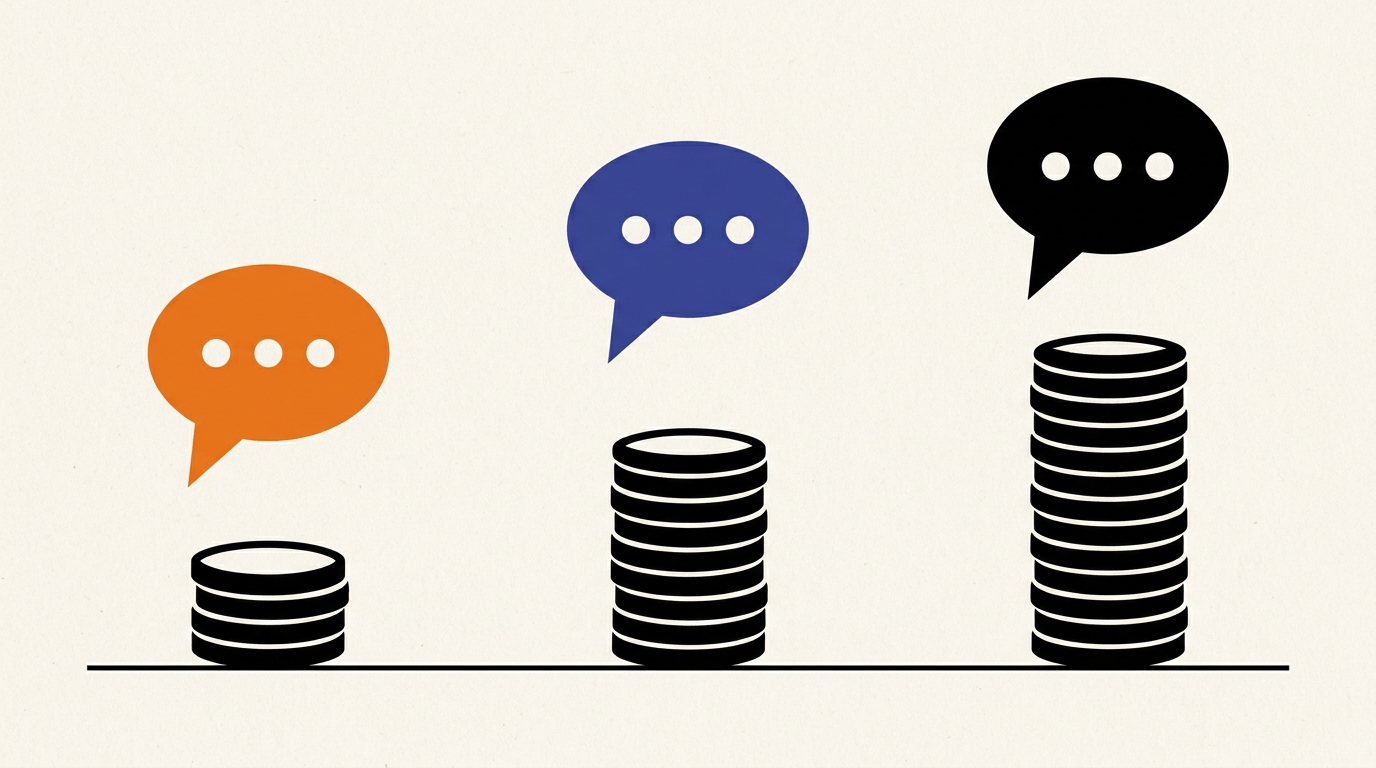
If you speak more than one language, you have probably had this thought in the middle of a chat with AI:
“Should I ask this in English? Will I get a better answer?”
It is a fair question. Maybe you think in Spanish, work in English, or write to family in Chinese. Maybe someone told you that “AI just works better in English” and left it at that.
The honest answer is: yes, the language can matter — but usually less than the folklore says, and not always in the direction you would expect.
Language can change three separate things: what your words cost, how long the answer takes, and how good the answer is. Let us look at each one, in plain language.
TL;DR
- AI does not read words the way we do. It reads tokens (small pieces of text), and the same meaning can need very different numbers of tokens in different languages.
- On one large, fair test of the same 2,009 sentences, Spanish needed about 32% more tokens than English with OpenAI’s newer tokenizer, and Chinese needed about 28% more. With an older OpenAI tokenizer, the gap was much bigger: 55% for Spanish and 91% for Chinese.
- It depends on the machine doing the chopping. On Qwen’s tokenizer, Chinese needed only about 7% more tokens than English, while Spanish needed about 52% more. Compared with OpenAI’s older tokenizer, the ranking flips.
- For answer quality, English usually comes first on the published tests, but Spanish is often close behind. Chinese tends to drop a bit more, and the mini and nano OpenAI models lose the most.
- Speed follows the token count: more tokens generally means more waiting, although nobody should treat that as an exact stopwatch rule.
- The practical rule is simple: write in the language you think in best. A clear question in Spanish beats a confused question in English.
A Tale of One Question in Three Languages
Imagine you ask an AI assistant the same favour in three languages:
- English: “Please explain how to save for a house, step by step.”
- Spanish: “Por favor, explícame cómo ahorrar para una casa, paso a paso.”
- Chinese: “请一步步解释如何存钱买房。”
A human sees one request, said three ways.
The AI sees something else first. Before it can think about houses or savings, a piece of software called a tokenizer chops your text into tokens, and the model works with those pieces.
That chopping step is where the story starts, because the pieces are not cut equally in every language.
Meet the Token: The Invisible Meter
A token is a small piece of text. Sometimes it is a whole word. Sometimes it is half a word, a letter, a space, or a common group of characters.
Here is the easiest way to picture it:
Think of a taxi meter. The car is your text. The meter does not charge you for the trip as a whole. It charges for small units of distance. Tokens are those units for AI.
Why should you care about the meter? Because in most AI services that charge by usage, you pay per token. Tokens are also what fill up the model’s memory of the conversation, and the model produces its answer token by token.
So the same trip can cost different amounts depending on how the meter counts it. And the meter was mostly calibrated on English roads.
flowchart LR
    A["You write a question"] --> B["Tokenizer chops it into tokens"]
    B --> C{"How many tokens?"}
    C --> D["Cost and memory space"]
    C --> E["Answer steps and waiting time"]
    F["Model size and training"] --> G["Answer quality"]
    B --> G
That one diagram is basically this whole article. Now let us put some numbers on it.
Cost: Same Meaning, Different Bill
To compare languages fairly, researchers use collections of sentences that say exactly the same thing in many languages. One famous collection is FLORES-200: the same sentences, carefully translated into 200 languages. It is like giving every language the same suitcase and seeing how much space it takes to pack it.
Three different tokenizers packed the same 2,009 sentences. The numbers are total tokens, and bigger means “more expensive to say the same thing.”
| Tokenizer | English | Spanish | Chinese (Simplified) |
|---|---|---|---|
OpenAI newer tokenizer (o200k_base) | 52,279 tokens | 68,887 (+32%) | 67,096 (+28%) |
OpenAI older tokenizer (cl100k_base) | 52,835 tokens | 81,735 (+55%) | 101,138 (+91%) |
| Qwen tokenizer (Qwen-7B-Chat) | 53,726 tokens | 81,882 (+52%) | 57,735 (+7%) |
One attribution note: the newer OpenAI row is my own count, not a number from Petrov’s table, whose published CSV has no o200k_base column. I ran OpenAI’s tiktoken library with o200k_base over the repo’s FLORES-200 dev + devtest sentences, joined into one text as Petrov’s script does. As a check, my cl100k_base rerun reproduced their published totals exactly. Counting sentence by sentence instead gives +88% for Chinese on cl100k_base and +26% on o200k_base, and Spanish barely changes.
Three lessons hide in this table:
- English usually gets the best deal on these tokenizers. In my reading, that is not a law of nature but a side effect of what text the tokenizer practised on.
- OpenAI’s newer tokenizer narrowed the gap. On OpenAI’s older one, Chinese cost almost double. On the newer one, Spanish and Chinese are close to each other.
- The winner depends on the tokenizer. Qwen’s tokenizer handles Chinese beautifully and Spanish much less efficiently, which is almost the opposite story.
Two caveats before you worry about your wallet.
First, if you use a normal chat app with a flat subscription, nobody sends you a per-token bill. These numbers land directly on people and companies that pay for AI by usage. Indirectly, they also affect everyone’s usage limits and how much text fits into one conversation.
Second, these exact numbers belong to these exact tokenizers. Another AI company may chop text differently. That is not a detail; it is one of the main points of this article.
Speed: Why More Tokens Can Mean More Waiting
AI writes its answers token by token, a bit like a very fast typist who can only press one key at a time.
The logic is simple: if an answer needs more tokens, there are more steps to type out. A longer question also takes more steps to read before the typing starts.
That means the language with the higher token count will generally feel a little slower, and fill the conversation memory sooner.
One caveat: this speed point is a reasonable conclusion from how these systems work, not something we measured with a stopwatch for this article. Server load, the model’s size, and how long the answer is can easily matter more on any given day. Treat speed as “usually a gentle headwind,” not a promise.
Correctness: Is the Answer Actually Worse?
Cost is interesting, but this is the question most people really mean:
“Am I getting a dumber AI when I don’t write in English?”
Researchers test this with big exam-style question sets, translated carefully into other languages. The famous one is called MMLU: thousands of multiple-choice questions across 57 subjects, from history to law. The cleanest way to read the results is: for the same model, how close does each language get to that model’s English score?
| Model (published tests) | Spanish vs its English | Chinese vs its English |
|---|---|---|
| Claude Sonnet 4.5 (deprecated by Anthropic on 2026-09-30) | 98.2% | 96.9% |
| Claude Haiku 4.5 | 96.4% | 94.2% |
| OpenAI o3-high | 97.6% | 95.7% |
| OpenAI gpt-4o-mini | 94.4% | 89.1% |
| OpenAI gpt-4.1-nano | 93.4% | 88.6% |
The Claude percentages are Anthropic’s own, measured with extended thinking. The OpenAI percentages are my calculation: each language score divided by the same model’s English MMLU score from the simple-evals README.
Read that table like this: if a model scores 100 points in English, a score of 96.9% in Chinese means it keeps almost 97 of those points. So no, you are not talking to a “dumb version” of the AI.
But two patterns matter:
- Spanish is usually close. On the Claude models and o3-high above, it keeps roughly 96–98% of the English score.
- The mini and nano models struggle more. The two little, fast, cheap OpenAI models lose the most outside English, down to about 89% in Chinese. The smaller the model, the more it seems to lean on English.
This comparison made me sit up. On this same exam, OpenAI’s gpt-4.1 answering in Chinese (86.1 points) scored slightly below the smaller gpt-4.1-mini answering in English (87.5 points). And gpt-4.1 in Spanish (87.6) basically tied that smaller model in English.
In plain words: switching language can cost you roughly one model “step”, as if you had quietly picked the next model down. This is a medium-confidence reading of one benchmark, not a universal law. But it is a good reason to care more about language when you are choosing between two similar models.
An exam is not your life. These tests measure exam-style questions, not explaining a recipe to your grandmother, drafting a kind email, or helping with homework. Whether a gap of about 2 to 11 percentage points is noticeable in everyday chat is my own judgment, not something these tests measured. My judgment is that it usually is not, which is exactly why the five-minute test below uses your questions instead.
The Plot Twist: It Depends on the Machine
If this article has one idea worth remembering, it is this:
“Which language is cheaper or better?” has no answer until you ask “on which AI?”
The tokenizer results showed it for cost: Chinese is the expensive one on OpenAI’s older tokenizer, roughly tied with Spanish on the newer one, and the cheap one on Qwen’s.
The same is true for quality. The numbers in this article come from specific published models by Anthropic and OpenAI. Some are no longer the newest: Anthropic’s docs list Sonnet 4.5 as deprecated since 2026-09-30, for example. A model built with extra care for Chinese may behave quite differently from the pattern above.
So please do not turn this into “English always wins.” Turn it into something more useful: every AI has a native accent, and it is worth knowing your AI’s.
If you want the builder’s side of language technology, I covered Building Google Translate: Before LLMs and With Modern AI separately. This article is the user’s side of that same coin.
So, Which Language Should You Use?
Here is the checklist I would give a friend:
- Start with the language you think in best. Clear thinking beats language optimisation. A precise question in your strongest language will beat a wobbly question in English.
- Say what language you want the answer in. Do not hope the AI guesses. “Answer in Spanish” or “请用中文回答” takes two seconds and removes a whole category of mix-ups. Anthropic’s multilingual guide recommends the same. It adds one tip: write in the native script, not transliteration, so Chinese characters rather than pinyin.
- For important work, pick the stronger model, not just the faster one. In these tests, the mini and nano models drop the most outside English. If the answer matters, this is where an upgrade actually buys you something.
- If you are fluent in English and choosing between two similar models, English is a reasonable tie-breaker — especially for Chinese on the tested OpenAI models. A tie-breaker, though. Not a rule.
- If you pay for AI by usage (or build apps for others), measure your own languages. Do not copy the table from this article onto a different model. Your users’ real sentences, on your model’s tokenizer, are the only numbers that bill you.
And the flip side, just as important: if your audience reads Spanish, answer in Spanish. A technically perfect English answer that your reader has to struggle through is not the better answer.
Try It Yourself in Five Minutes
You do not need code, a lab, or this article’s permission. You need one question you actually care about.
- Pick a real question with a checkable answer: plan a 3-day trip with a budget, explain a school topic, summarise a text. Write down what a good answer must include.
- Ask it in language A in a fresh chat, with your usual model. Save the answer.
- Ask the same thing in language B in another fresh chat, same model. Translate the meaning carefully — names, numbers, and details included.
- Compare like a teacher, not a fan. Which answer followed your instructions better? Which made a factual slip? Which was more useful, not just longer?
- Optional peek: paste both questions into a free online “tokenizer” tool to see the token counts with your own eyes. Counts differ by tool. That difference is the lesson.
If both answers are equally good for your questions, congratulations: you have your answer, and it cost you five minutes instead of a stranger’s opinion.
If you build with APIs and like a little code, you can count tokens yourself. This sketch counts the three questions from the start of this article with tiktoken and the o200k_base tokenizer from the cost table:
import tiktoken

enc = tiktoken.get_encoding("o200k_base")

questions = {
    "English": "Please explain how to save for a house, step by step.",
    "Spanish": "Por favor, explícame cómo ahorrar para una casa, paso a paso.",
    "Chinese": "请一步步解释如何存钱买房。",
}

for language, text in questions.items():
    print(language, len(enc.encode(text)))
Count with the tokenizer of the model you actually use. For Claude models, Anthropic’s token-counting endpoint does the same job.
What This Evidence Does Not Prove
A short list of limits, because friendly should not mean sloppy:
- These are specific tokenizers and specific published models, measured at specific times. Today’s newest models may do better — the published multilingual tables simply lag behind.
- We have good token numbers for OpenAI’s and Qwen’s tokenizers, but not for Claude’s, which I did not measure. Anthropic offers a free token-counting endpoint. It also says Claude 4.7 and later use a newer tokenizer that produces about 30% more tokens for the same text. Nobody should borrow OpenAI’s ratios and paste them onto Claude.
- The quality tests are translated exam questions. They are a useful signal, not a measurement of everyday conversation, humour, culture, or kindness.
- The speed effect is inferred from token counts, not stopwatch-measured here.
- The world is bigger than three languages. The research papers behind this article show the unfairness can be far more extreme for languages with fewer digital resources. Petrov et al. found the same text can need up to 15 times more tokens in some languages. English, Spanish, and Chinese are, relatively speaking, the lucky ones.
The Bottom Line
So, does it matter what language you talk to AI in?
A little — and now you know where the “little” hides. It hides in the token meter (cost), in the typing steps (speed), and in a small quality gap that is widest for the mini and nano models (correctness). It also changes from one AI to another, because each one was raised on a different diet of languages.
Do not let any of this push you out of the language you think in. Treat it like knowing that one taxi company has a fairer meter: worth knowing, occasionally worth choosing, never a reason to stop going where you need to go.
Ask your question clearly, say what language you want back, pick a model that respects your words, and test it once yourself. That is most of the advantage, in any language.
Related Reading
- Why We All Suddenly Talk Like AI People — from the same series: how AI words moved into everyday speech.
- 1M vs 200K Context Windows: What Actually Changes for LLM Apps — what a bigger conversation memory changes, and what still breaks, in LLM apps.
Sources
- Petrov et al., “Language Model Tokenizers Introduce Unfairness Between Languages” — 2023-05-17 — how tokenizers create cost, latency, and context differences between languages, with token lengths up to 15 times apart.
- Petrov et al., tokenization-fairness repository, FLORES-200 data, and tokenization lengths — accessed 2026-10-30 — the FLORES-200 sentences, the counting script that joins all sentences into one text, and the published corpus token totals for OpenAI’s older
cl100k_baseand Qwen’s tokenizer (Qwen-7B-Chat) used in the cost table. - OpenAI, tiktoken — accessed 2026-10-30 — the tokenizer library I used for my own
o200k_basecount (and thecl100k_basevalidation rerun) in the cost table. - Ahia et al., “Do All Languages Cost the Same? Tokenization in the Era of Commercial Language Models” — 2023-05-23 — per-token pricing fairness across 22 languages.
- Hendrycks et al., “Measuring Massive Multitask Language Understanding” — 2020-09-07 — the MMLU test: 57 tasks, from elementary mathematics and US history to computer science and law.
- Anthropic, “Multilingual support” — accessed 2026-10-30 — Claude Sonnet 4.5 and Haiku 4.5 performance by language relative to English (measured with extended thinking), plus the advice to state the response language and use native script.
- Anthropic, “Token counting” — accessed 2026-10-30 — the free token-counting endpoint, and the note that Claude 4.7 and later use a newer tokenizer with about 30% more tokens for the same text.
- Anthropic, “Model deprecations” — accessed 2026-10-30 — Claude Sonnet 4.5 deprecated on 2026-09-30, with retirement on 2026-11-30.
- OpenAI simple-evals, “Multilingual MMLU Benchmark Results” — accessed 2026-10-30 — per-language exam scores for OpenAI models.
- OpenAI simple-evals, README — accessed 2026-10-30 — the English exam scores I divided each language score by.