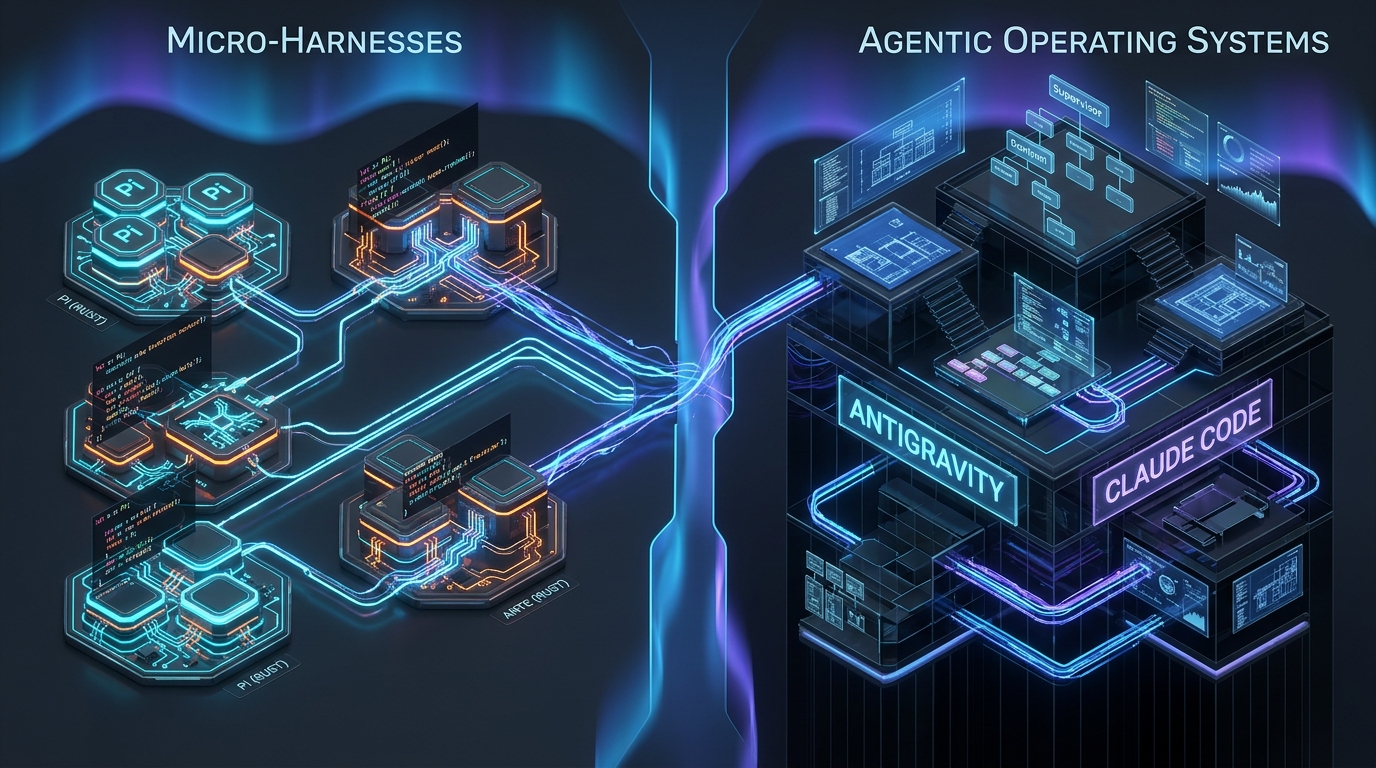
By mid-2026, “AI coding assistants” stopped being a single category. Engineering teams moved from short chat prompts to long-running autonomous loops. In this new world, runtime architecture dictates system limits. It determines your container density. It dictates how fast reasoning degrades as context fills up. It determines whether your enterprise code remains secure.
Today, the tooling ecosystem has split into two competing design camps:
- Micro-Harnesses & Cellular Engines: Tools like Pi (pi.dev), Ante (ante.run), Aider, and Goose. These are lightweight execution micro-kernels. They use tiny boot prompts (under 1,500 tokens). They run in tight memory envelopes (15MB to 100MB RAM). They excel at rapid execution, git-native rollbacks, session branching, and high-density parallel swarms.
- Agentic Operating Systems (AgentOS): Platforms like Antigravity CLI (
agy), Claude Code, Opencode, and GitHub Copilot CLI/Workspace. These are full-stack development platforms. They provide supervisor-subagent hierarchies, dynamic tool discovery, automated plan modes, ReBAC access controls, and persistent compliance artifacts.
Choosing between a micro-harness and an AgentOS is not a matter of CLI ergonomics. It is a fundamental engineering trade-off between token sovereignty, container density, context poisoning resilience, and enterprise governance.
Here is how both classes work under the hood, how they perform under heavy load, and how high-performing teams combine them into production-grade multi-agent pipelines.
TL;DR
- The Core Divide:
- Micro-Harnesses (Pi, Ante, Aider, Goose): Built as ephemeral execution engines. They protect context windows with sub-1,000 token boot prompts. They run in tight memory envelopes (Ante uses under 100MB per worker in Rust). They use session DAGs (
/fork) or Git commits for instant rollbacks when reasoning diverges. - Agentic Operating Systems (Antigravity CLI, Claude Code, Opencode, Copilot): Built as distributed control planes. They manage multi-system workflows across Jira, GitHub, Slack, and databases. They enforce sandbox security policies (
proceed-in-sandbox). They coordinate subagent trees with reactive wakeups and maintain project knowledge in structured artifact stores.
- Micro-Harnesses (Pi, Ante, Aider, Goose): Built as ephemeral execution engines. They protect context windows with sub-1,000 token boot prompts. They run in tight memory envelopes (Ante uses under 100MB per worker in Rust). They use session DAGs (
- Resource Footprint (20 Parallel Tasks in Docker):
- Ante (Rust): ~1.9 GB peak RAM, 1.3% average CPU, 24 MB disk read.
- Opencode (TypeScript): ~12.9 GB peak RAM, 3.8% average CPU, 2.2 GB disk read.
- Claude Code (Node.js): ~13.8 GB peak RAM, 12.1% average CPU, 17.4 GB disk read.
- Token Economics: Micro-harnesses boot with ~950 to 1,500 tokens. This leaves 99% of the context window for code. AgentOS platforms often consume 4,000 to 12,000+ tokens on boot for system rules, planning prompts, and tool schemas. This overhead can cause attention degradation during deep refactors.
- When to Pick Micro-Harnesses: High-density CI/CD swarms with 50+ parallel workers. Local interactive TDD refactoring. Embedded bot runtimes like OpenClaw. Air-gapped offline environments with Ante’s embedded GGUF. Any workflow where you demand complete control over every prompt token.
- When to Pick AgentOS Platforms: Complex brownfield monorepos. Multi-tool workflows spanning Jira, Chrome, and databases. Compliance-heavy environments requiring fine-grained sandbox policies. Teams that need persistent architectural documentation.
- The Two-Tier Production Pattern: You do not have to pick a single winner. The strongest engineering teams deploy an AgentOS (Antigravity or Copilot) as the Supervisory Control Plane to manage tickets, specs, and PR gates. They dispatch Micro-Harnesses (Ante, Pi, or Aider) as Ephemeral Workers in isolated Git worktrees.
What You Will Learn Here
- The architectural taxonomy contrasting Minimalist Micro-Harnesses with Agentic Operating Systems (AgentOS).
- In-depth mechanics of Micro-Harnesses: Pi (session DAGs), Ante (Rust cellular engine and embedded GGUF), and Aider/Goose (git-native loops and repo-maps).
- In-depth mechanics of AgentOS Platforms: Antigravity CLI (supervisor IPC and lazy MCP), Claude Code (plan mode), and GitHub Copilot / Opencode (enterprise compliance).
- Quantitative Docker benchmarks: Memory density, CPU usage, and disk I/O across 20 parallel tasks.
- Token budgeting: Boot overhead, attention degradation, and context poisoning recovery.
- Enterprise security: Raw terminal execution versus multi-tier sandboxing (
proceed-in-sandbox). - A 7-point Scenario Decision Matrix for production adoption.
- The Two-Tier Composite Blueprint for production platform engineering.
1. The 2026 Great Divergence: Micro-Harnesses vs. AgentOS
The split between micro-harnesses and AgentOS platforms reflects a classic tension in software engineering: single-responsibility micro-tools versus batteries-included integrated platforms.
The Micro-Harness Mindset (Unix Philosophy)
Micro-harnesses treat the model context window as precious, volatile memory. They assume:
- Every prompt token costs latency, money, and cognitive attention.
- Injected meta-prompts, hidden rules, and large tool schemas cause instruction drift.
- The agent should be an ephemeral worker that executes a specific task, commits clean diffs, and terminates.
The AgentOS Mindset (Distributed Operating System)
AgentOS platforms treat coding as an organizational coordination problem. They assume:
- Code changes require cross-system context across Jira tickets, Slack threads, database schemas, and browser tests.
- Developers need top-down architectural planning, automated progress tracking, and guardrails to prevent accidental infrastructure damage.
- The platform should act as a supervisor that coordinates specialized subagents, monitors background cron jobs, and publishes persistent deliverables.
flowchart TD
    subgraph Class1["Class 1: Micro-Harnesses & Cellular Engines"]
        PiCore["Pi: Sub-1k Token Boot + Session DAG (/fork)"]
        AnteCore["Ante: ~15MB Rust Binary + Embedded GGUF"]
        AiderCore["Aider/Goose: Git-Native Loop + Repo-Map"]
    end

    subgraph Class2["Class 2: Agentic Operating Systems (AgentOS)"]
        AGYCore["Antigravity CLI: Supervisor Hierarchy + Lazy MCP"]
        ClaudeCore["Claude Code: Plan Mode + Deep Sonnet Reasoning"]
        CopilotCore["GitHub Copilot: Enterprise SSO + PR/Issue Gates"]
    end

    Class2 -.->|"Dispatches Isolated Tasks"| Class1
    Class1 -.->|"Returns Verified Diffs"| Class2
2. Deep Dive: Class 1 — Micro-Harnesses & Cellular Engines
2.1 Pi (pi.dev / badlogic/pi-mono) — The Minimalist Unix Harness
Maintained by Mario Zechner and Armin Ronacher, Pi is designed to be the smallest useful coding harness you can embed, extend, and reason about.
Key Primitives:
- Strict 4-Tool Baseline: Exposes only
read(with line slicing),write,edit(exact string replacement), andbash. - Sub-1,000-Token Boot Prompt: Leaves 99% of context for code and compiler feedback.
- Session DAG Engine (
/tree,/fork): Instead of an append-only chat history, sessions are stored as Directed Acyclic Graphs. If the model makes a bad architectural choice on turn 4, you do not have to restart the session. You run/forkfrom turn 3. This scrubs the failed path from the active context window. - The Engine Behind OpenClaw: The autonomous gateway OpenClaw embeds Pi directly via
createAgentSession(). Pi provides the deterministic execution loop, while OpenClaw manages messaging channels above it.
              ┌── [Node 3A: Refactor Auth via JWT] ── [Node 4A: Broken Tests ✗]
              │
[Node 1] ── [Node 2]
              │
              └── [Node 3B: /fork -> Refactor Auth via Cookies] ── [Node 4B: Tests Passed ✓]
2.2 Ante (ante.run / AntigmaLabs) — The High-Performance Rust Engine
Ante represents a major engineering leap in resource efficiency. While most coding agents run on Node.js or Python, Ante is written in pure Rust and ships as a single ~15MB binary with zero runtime dependencies.
Key Primitives:
- Massive RAM Efficiency: Consumes under 100MB per worker. This allows developers to run 50+ concurrent agents on a standard laptop without memory exhaustion.
- Embedded Offline GGUF Inference: Includes a native local model inference engine directly in the Rust binary. You can run air-gapped coding loops without spinning up an external Ollama or vLLM daemon.
- 4 Built-in Agent-Org Swarm Topologies:
- Independent: Parallel workers run isolated tasks and merge results via an aggregator.
- Decentralized (Peer-to-Peer): Multi-round peer reviews and debate without a central coordinator.
- Centralized Iterative: Top-down orchestrator dispatching subtasks against automated test gates.
- Hybrid Iterative: Top-down architectural planning followed by peer refinement rounds.
- Decoupled Client-Daemon (
ante serve): The daemon runs headlessly over JSONL or WebSocket. This makes it trivial to embed into editor extensions and CI pipelines.
flowchart TD
    subgraph Row1["Parallel & Peer Patterns"]
        subgraph Pattern1["1. Independent"]
            Task1["Input Task"] --> A1["Agent A"]
            Task1 --> B1["Agent B"]
            A1 --> Agg["Aggregator"]
            B1 --> Agg
        end

        subgraph Pattern2["2. Decentralized (P2P)"]
            A2["Agent A"] <-->|"Peer Review"| B2["Agent B"]
        end
    end

    subgraph Row2["Iterative & Hybrid Patterns"]
        subgraph Pattern3["3. Centralized Iterative"]
            Orch3["Central Orchestrator"] --> W1["Worker 1"]
            W1 --> Gate3{"Test Gate"}
            Gate3 --"Pass / Fail"--> Orch3
        end

        subgraph Pattern4["4. Hybrid Iterative"]
            Orch4["Orchestrator Plan"] --> P1["Peer Agent 1"]
            Orch4 --> P2["Peer Agent 2"]
            P1 <-->|"Peer Review"| P2
            P1 --> Eval4["Orchestrator Eval"]
            P2 --> Eval4
        end
    end
2.3 Aider & Goose — Git-Centric & Open Foundation Engines
Aider: The Git-Native Pioneer
- Atomic Git Commits: Every file edit is immediately committed to Git with a generated semantic commit message. The undo engine is simply
git reset. - Tree-sitter Repo-Map: Instead of dumping whole files into context, Aider extracts AST signatures (class definitions, function signatures, exported types). It provides repository-wide context in under 1,000 tokens.
- Zero Meta-Prompt Bloat: Direct developer-in-the-loop pairing with zero intermediary planner agents.
Goose (Block / Linux Foundation)
- Open Agent Foundation: An open-source, vendor-agnostic agent governed by the Linux Foundation’s Agentic AI Foundation.
- Lean Tool Host: Connects to standard MCP tools dynamically without imposing heavy supervisor frameworks.
3. Deep Dive: Class 2 — Agentic Operating Systems (AgentOS)
3.1 Antigravity CLI (agy / Google Antigravity) — The Enterprise AgentOS
Antigravity CLI is the command-line engine of Google’s AI-first Antigravity development platform. It is built to manage large-scale brownfield software engineering.
Key Primitives:
- Supervisor-Worker IPC & Reactive Wakeups: The primary agent spawns specialized child subagents (
invoke_subagent) for research, refactoring, and code review. While workers run, the supervisor enters a zero-polling sleep state. It wakes reactively when child messages arrive. - Progressive Disclosure & Lazy MCP Host: High-capacity enterprise tools across Jira, Google Workspace, Snowflake, and Playwright are queried lazily via
call_mcp_tool. This prevents prompt bloat. - Persistent Brain Artifacts: Deliverables, architecture specs, and test summaries are stored in a dedicated workspace brain directory at
<appDataDir>/brain/<conversation-id>/. This separates ephemeral chatter from permanent deliverables. - Multi-Tier Execution Policies: Enforces
always-proceed,request-review, andproceed-in-sandboxto protect corporate environments.
3.2 Claude Code (Anthropic) — Deep Model Optimization & Plan Mode
Claude Code is Anthropic’s official agentic CLI. It is built to showcase the extended reasoning and tool-use capabilities of Claude 3.7 Sonnet and Opus.
Key Primitives:
- Dedicated Plan Mode: Forces the model into an upfront architectural decomposition phase before modifying code.
- Deep Model-Specific Heuristics: Tailored prompt formatting and tool-calling structures tuned specifically for Claude’s reasoning tokens.
- Trade-off: High memory and prompt boot footprint (~8,500+ tokens baseline). It optimizes for single-session deep reasoning rather than high-density swarms.
3.3 Opencode & GitHub Copilot CLI — Indexing & Enterprise Compliance
- Opencode: TypeScript-based open-source CLI agent supporting dozens of model endpoints. It includes deep repository vector indexing and AST analysis.
- GitHub Copilot CLI / Workspace: Tightly integrated into GitHub Enterprise SSO. It enforces corporate DLP policies, audit trails, and automated pull request workflows.
4. Quantitative Benchmarks & Resource Economics
4.1 Docker Resource Benchmark (20 Concurrent Parallel Tasks)
Measurements across 20 identical parallel engineering tasks executed in isolated Docker containers:
| Metric | Ante (ante.run / Rust) | Claude Code (Node.js) | Opencode (TypeScript) |
|---|---|---|---|
| Peak Memory (RAM) | 1,968 MiB (~1.9 GB) | 13,877 MiB (~13.8 GB) | 12,944 MiB (~12.9 GB) |
| Average Memory per Worker | ~98 MiB | ~693 MiB | ~647 MiB |
| Average CPU Usage | 1.3% | 12.1% | 3.8% |
| Total Disk Read | 24 MB | 17,444 MB | 2,224 MB |
| Total Disk Write | 2,785 MB | 15,116 MB | 31,427 MB |
| Peak Disk Read Rate | 3.5 MB/s | 263.9 MB/s | 284.1 MB/s |
Ante uses ~7× less peak memory, ~9× less average CPU, and ~5× less disk I/O than traditional Node/Electron-based coding harnesses.
4.2 Token Economics & Attention Degradation
- The “Lost in the Middle” Penalty: When an agent boots with 8,000 to 12,000 tokens of system rules, planning instructions, and tool definitions, the LLM’s attention on subtle syntax nuances degrades by up to 20%.
- Context Poisoning Recovery:
- Micro-Harnesses: Use hard pruning like Pi’s
/forkDAG rewind or Aider’sgit reset. Failed reasoning runs are physically deleted from active context. - AgentOS Platforms: Rely on LLM-driven compaction, conversation summaries, and external brain artifacts.
- Micro-Harnesses: Use hard pruning like Pi’s
5. Security, Sandboxing & Enterprise Governance
flowchart LR
    subgraph DevZone["Developer Zone: High Speed & Autonomy"]
        Micro["Micro-Harness (Pi / Ante / Aider)"]
        YOLO["Interactive Shell (Fast Local Dev)"]
        GitRollback["Git Commit / Session DAG Rollback"]
        Micro --> YOLO --> GitRollback
    end

    subgraph EnterpriseZone["Enterprise Zone: Governance & Compliance"]
        AgentOS["AgentOS Control Plane (Antigravity / Copilot)"]
        ReBAC["ReBAC / SSO Access (OpenFGA)"]
        Sandbox["Container Sandbox (gVisor / Docker)"]
        AuditLog["Persistent Brain Artifacts & Audit Trail"]
        AgentOS --> ReBAC
        AgentOS --> Sandbox
        AgentOS --> AuditLog
    end

    AgentOS -.->|"Dispatches Task Contract"| Micro
Micro -.->|"Returns AST Diff & Test Log"| AgentOS- Permission Gating:
- Micro-Harnesses: Operate with direct shell authority by default for maximum speed. They rely on OS containers or Git commits to limit the blast radius.
- AgentOS Platforms: Enforce multi-tier execution policies (
always-proceed,request-review,proceed-in-sandbox), ReBAC identity, and tamper-proof audit trails.
- MCP Tool Supply-Chain Security:
- Loading dozens of third-party MCP servers into an agent creates potential prompt injection and data exfiltration vectors.
- Antigravity CLI mitigates this via lazy schema loading (
call_mcp_tool), isolating unvetted tools until explicitly authorized.
6. Master Comparison Matrix
| Feature Dimension | Micro-Harnesses (Pi, Ante, Aider) | Agentic Operating Systems (Antigravity, Claude Code, Copilot) |
|---|---|---|
| Primary Philosophy | Unix micro-tool / Cellular engine | Distributed Operating System (AgentOS) |
| System Boot Overhead | Under 1,000–1,500 tokens | 4,000–12,000+ tokens |
| Memory Footprint | ~15MB–100MB per worker | ~500MB–1.5GB+ per worker |
| Tool Surface | 4 atomic primitives (read, write, edit, sh) | Full native suite + Browser + Dynamic MCP |
| Multi-Agent Model | External CLI pipes, TS SDK, or native P2P swarms | Supervised actor hierarchy (invoke_subagent) + IPC |
| Session Model | Session Tree DAGs (/fork) or Git commits | Persistent threads + Workspace Brain Artifacts |
| Local Model Support | Native embedded GGUF (Ante) or Ollama/OpenAI API | Cloud-first; multi-provider SDK endpoints |
| Security Posture | Host permissions (YOLO default; external Docker) | Enterprise sandboxing (proceed-in-sandbox) & SSO |
| Concurrency Ceiling | 50–100+ concurrent workers on single host | 2–5 heavy orchestrated workers per host |
| Primary Embedding API | TypeScript (createAgentSession) / Rust JSONL | Python SDK (google-antigravity) / Platform CLI |
| Flagship Reference | OpenClaw (Gateway) / Ante Rust Swarms | Antigravity IDE & 2.0 / GitHub Enterprise |
7. Scenario Decision Matrix
graph TD
    Start["What is your primary engineering constraint?"] --> Q1{"Do you need 20+ parallel workers or offline GGUF?"}
    Q1 --"Yes (High-density swarm, air-gapped)"--> Pick_Ante["Choose Ante (ante.run / Rust)"]
    Q1 --"No"--> Q2{"Do you need surgical token control & session rewinds?"}
    Q2 --"Yes (Interactive TDD, OpenClaw embedding)"--> Pick_Pi["Choose Pi (pi.dev / TS SDK) or Aider"]
    Q2 --"No"--> Q3{"Do you need enterprise MCP, Jira triage & policy sandboxing?"}
    Q3 --"Yes (Monorepo governance, enterprise)"--> Pick_AGY["Choose Antigravity CLI (agy) or Claude Code"]
Q3 --"No"--> Pick_Hybrid["Adopt Two-Tier Hybrid Architecture"]| Engineering Scenario | Recommended Class & Tool | Primary Justification |
|---|---|---|
| High-Density Swarm CI/CD (20–100 parallel workers) | Micro-Harness: Ante (ante.run) | Pure Rust runtime uses ~7× less RAM (~1.9 GB for 20 workers vs 13.8 GB in Node). |
| Interactive Terminal TDD & Local Refactoring | Micro-Harness: Pi (pi.dev) / Aider | Sub-1,000 token boot prompt, instant DAG branching (/fork), atomic git commits. |
| Custom Bot Gateways & Agent Products | Micro-Harness: Pi (via TS SDK / OpenClaw) | Embeddable createAgentSession with decoupled event loop and session state. |
| Air-Gapped / Offline Local Environments | Micro-Harness: Ante (ante.run) | Native embedded GGUF engine runs local weights without external daemon dependencies. |
| Multi-Agent Architectural Debate & Red Teaming | Micro-Harness: Ante (Peer-to-Peer) | Built-in decentralized consensus topologies without coordinator bottlenecks. |
| Brownfield Monorepo Migration & Jira Orchestration | AgentOS: Antigravity CLI (agy) | Supervisor-subagent IPC, lazy enterprise MCP (Jira, DB, Browser), persistent brain artifacts. |
| Deep Exploratory System Reasoning & Plan Mode | AgentOS: Claude Code | Dedicated planning phase and optimized reasoning heuristics for Claude 3.7 Sonnet. |
| Regulated Enterprise Codebase with Strict DLP & SSO | AgentOS: GitHub Copilot / Antigravity | Enterprise policy governance, sandboxed tool gates, centralized audit logging. |
8. The Production Blueprint: Two-Tier Composite Architecture
In mature engineering organizations, teams do not pick a single agent. They deploy a Two-Tier (or Tri-Tier) Composite Pipeline:
sequenceDiagram
    autonumber
    participant Dev as Human Engineer
    participant ControlPlane as Tier 1: Supervisory Control Plane (AgentOS / Antigravity / Copilot)
    participant SwarmPlane as Tier 2: Exploration Swarm (Ante Rust Workers)
    participant ExecPlane as Tier 3: Execution Loop (Pi / Aider in Worktrees)

    Dev->>ControlPlane: Assign Jira epic with acceptance criteria
    ControlPlane->>ControlPlane: Parse Jira ticket, check ReBAC, build OpenSpec contract
    ControlPlane->>SwarmPlane: Dispatch 20 Ante workers in Docker (under 2 GB RAM)
    Note over SwarmPlane: Ante workers run peer debate & AST exploration
    SwarmPlane-->>ControlPlane: Return validated architecture blueprint & test matrix
    ControlPlane->>ExecPlane: Spawn isolated Pi instances in dedicated Git worktrees
    Note over ExecPlane: Pi executes lean TDD loops (under 1k token clean prompt)
    ExecPlane-->>ControlPlane: Return AST diffs & passing test logs via JSON streams
    ControlPlane->>ControlPlane: Run policy hooks (hooks.json) & publish Brain Artifact
    ControlPlane->>Dev: Deliver completed PR with verification report
Why the Two-Tier Pattern Wins:
- Context Window Cleanliness: The execution worker’s prompt is never polluted with Jira ticket discussions, enterprise MCP schemas, or Slack comments. It receives only the immediate task contract and code files.
- Resource Efficiency: Heavy architectural planning and governance run once on the control plane. High-volume parallel exploration runs on high-density Rust workers (Ante) at minimal RAM cost.
- Deterministic Verification: The control plane enforces security policies and integration test gates before merging diffs back into the main branch.
9. Failure Modes and Operational Runbook
| Failure Mode | Class Affected | Root Cause | Engineering Mitigation |
|---|---|---|---|
| Context Compounding Drift | Micro-Harnesses | Long linear sessions without pruning degrade model attention. | Use /tree and /fork in Pi or git reset in Aider to prune failed attempts. |
| Tool Execution Fatigue | AgentOS Platforms | Exposing dozens of eager MCP tools confuses model routing. | Migrate non-critical MCP servers to lazy schema evaluation (call_mcp_tool). |
| Container OOM Panics | AgentOS Platforms | Running multiple Node/Electron agents concurrently on a single host. | Cap concurrency or delegate parallel swarm steps to Rust engines (Ante). |
| Worktree Merge Collisions | Both | Multiple concurrent subagents editing the same files. | Enforce strict Git worktree isolation per worker and lock file boundaries in tasks.md. |
| Indirect Prompt Injection | Both | Unvetted data from web scrapers or MCP tools altering agent behavior. | Enforce OS sandboxing (proceed-in-sandbox, Docker, gVisor) on all tool calls. |
Conclusion & Architectural Recommendations
The evolution of AI coding agents in 2026 confirms that no single tool wins every benchmark or production scenario:
- Reach for Micro-Harnesses (Pi, Ante, Aider, Goose) when you need high-speed local TDD, massive parallel container swarms (Ante’s ~7× RAM savings in Rust), embedded bot gateways (OpenClaw), or surgical session DAG rewinds (
/fork). - Reach for Agentic Operating Systems (Antigravity CLI, Claude Code, Opencode, Copilot) when you need a supervisory control plane to coordinate multi-system enterprise toolchains, enforce policy sandboxes, delegate tasks to subagents, and publish durable brain artifacts.
- Combine them into a Two-Tier Architecture for production scale: let Antigravity CLI or Copilot govern the control plane, let Ante swarm the exploratory search space, and let Pi or Aider write the code in isolated worktrees.
Sources
- Ante Documentation & Live Benchmarks: ante.run and
AntigmaLabs/ante(Terminal-Bench 2.1 at antigma.ai/eval, Resource Footprint at ante.run/benchmarks/compare_table). - Pi Documentation & Monorepo: pi.dev and
badlogic/pi-mono(@earendil-works/pi-coding-agent,pi-ai,pi-agent-core,pi-tui). - Mario Zechner: “What I learned building an opinionated and minimal coding agent” (November 30, 2025).
- Armin Ronacher: “Pi: The Minimal Agent Within OpenClaw” (January 31, 2026).
- Aider: Leaderboards, Git integration, and repository map architecture (aider.chat).
- Goose (Block / Linux Foundation): Open-source agent framework (github.com/block/goose).
- Google Antigravity Platform: Official Documentation, IDE Reference, and CLI Guide (antigravity.google).
- Claude Code: Official Anthropic Agentic CLI Documentation (docs.anthropic.com/en/docs/agents-and-tools/claude-code).
- Model Context Protocol: MCP Architectural Specification (modelcontextprotocol.io).